 Cardiovascular Physiology Concepts, 3rd edition textbook, Published by Wolters Kluwer (2021)
 Normal and Abnormal Blood Pressure, published by Richard E. Klabunde (2013)
The Pharmacologic Treatment of Myocardial Infarction
- Page 1: The Pathophysiology of Myocardial Infarction - Causes and Effects
- THIS PAGE: Rationale for Drug Therapy in Myocardial Infarction
- Page 3: Classes of Drugs Used to Treat Myocardial Infarction
Rationale for Drug Therapy in Myocardial Infarction
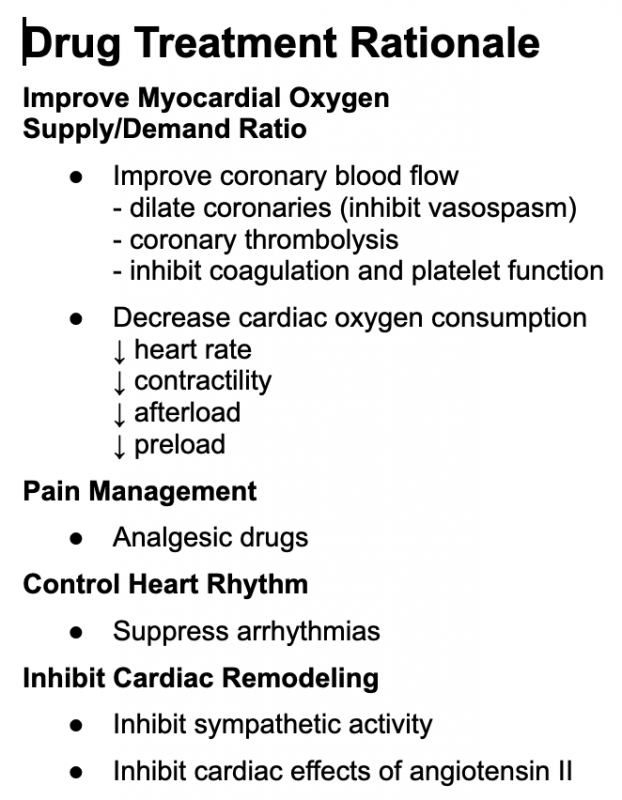 The most important goal of drug therapy early in acute myocardial infarction is to improve the oxygen supply/demand ratio for the heart. When this ratio is reduced by either decreased coronary flow (i.e., reduced oxygen delivery) or by an increase in oxygen demand (e.g., by increased cardiac work), oxygenation of the myocardial tissues declines. This leads to impaired cardiac function, which leads to the clinical signs associated with myocardial infarction. There are two strategies to improve the coronary supply/demand ratio: 1) restore normal coronary blood flow, and 2) decrease myocardial oxygen consumption.
Restoring Normal Coronary Blood Flow
The two major approaches for restoring normal cardiac perfusion are 1) percutaneous transluminal angioplasty (PCTA) and insertion of an intracoronary stent, and 2) administering a thrombolytic drug to induce clot lysis. Both procedures include anticoagulant drugs to inhibit new clot formation. Patients are also treated with antiplatelet drugs, which help to prevent recurrent thrombosis. Because coronary vasospasm can also contribute to reduced perfusion, vasodilators such as nitroglycerin are often given to prevent or reverse vasospasm.
Decreasing Myocardial Oxygen Consumption
Myocardial oxygen demand can be decreased by decreasing 1) heart rate, 2) contractility (inotropy), 3) ventricular afterload, and 4) ventricular preload. Because the heart is being stimulated by increased sympathetic activity and circulating catecholamines during infarction, drugs such as beta-blockers that inhibit sympathetic activity (sympatholytics) are commonly given. Systemic vasodilators are sometimes given to reduce systemic vascular resistance; however, care must be taken not to cause hypotension because this would reduce coronary perfusion pressure and blood flow. Finally, venous dilator drugs such as nitroglycerin are used to reduce ventricular preload, which reduces oxygen demand.
Other Drugs
Pain management is an important consideration because pain and associated anxiety stimulate sympathetic activity, which can be deleterious to the heart. Therefore, analgesic drugs such as morphine may be given in the acute setting to reduce pain. Morphine also has other beneficial effects as a vasodilator. Antiarrhythmic drugs are administered, particularly when there are serious ventricular rhythm disturbances. The administration of diuretic drugs depends on the severity of heart failure and fluid retention.
Long-Term Treatment
Because myocardial infarction usually occurs because of coronary artery disease, most patients are placed on long-term antiplatelet therapy to reduce vascular thrombosis. Most post-infarct patients are also treated with a beta-blocker because it blocks cardiac remodeling and reduces mortality following infarction. Angiotensin converting enzyme inhibitors, angiotensin receptor blockers, aldosterone antagonists also have a similar beneficial effect on remodeling and mortality.
Go to Next Page
Classes of Drugs Used to Treat Myocardial Infarction
Revised 02/03/2024
 Twitter
 Telegram
 LinkedIn
 WhatsApp
 Facebook
 Reddit