 Cardiovascular Physiology Concepts, 3rd edition textbook, Published by Wolters Kluwer (2021)
 Normal and Abnormal Blood Pressure, published by Richard E. Klabunde (2013)
The Pharmacologic Treatment of Hypotension cont.
- Page 1: Definition of Hypotension and its Causes
- THIS PAGE: Rationale for Pharmacologic Treatment of Hypotension
- Page 3: Drugs Used to Treat Hypotension
Rationale for Pharmacologic Treatment of Hypotension
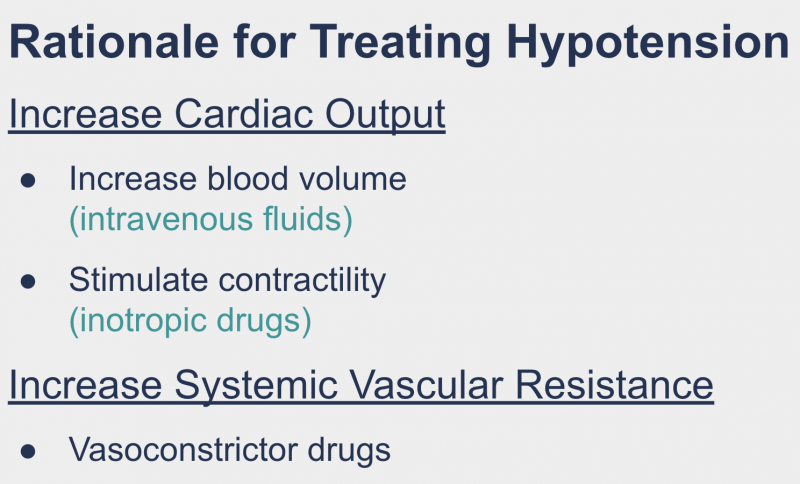 Arterial blood pressure can be elevated by increasing blood volume, which increases venous pressure and then cardiac output through the Frank-Starling mechanism. Therefore, in hypotensive states caused by volume depletion, intravenous fluids or whole blood are given to restore circulating volume and enhance cardiac output and arterial pressure. Drugs are also given that stimulate the heart to increase cardiac output by increasing heart rate and stroke volume. Many of these same drugs, as well as vasoconstrictor drugs that are specific for blood vessels, constrict the systemic vasculature and increase systemic vascular resistance. Drugs that increase arterial pressure by cardiac stimulation and vasoconstriction are called pressor agents. Such drugs are usually effective in increasing arterial pressure unless the heart and vasculature become refractory to such interventions, as can occur in the late stages of hypotensive shock.
Postural hypotension caused by autonomic neuropathy is difficult to treat pharmacologically because arterial pressure may be normal when lying down or sitting, but then falls upon standing because of impaired baroreceptor reflexes. There are, however, some non-drug interventions (e.g., breathing maneuvers, muscular contraction, limb compression) that may help patients in this situation. Other forms of postural hypotension may be caused by volume depletion (e.g., heat exhaustion, overuse of a diuretic), or because of the autonomic blocking effects of alpha-blockers or beta-blockers. In these cases, restoration of blood volume, or reducing the dose of a diuretic or autonomic blocker, may sufficiently maintain normal arterial pressures when standing.
Go to Next Page
Drugs Used to Treat Hypotension
Revised 01/14/2024
 Twitter
 Telegram
 LinkedIn
 WhatsApp
 Facebook
 Reddit