
 Cardiovascular Physiology Concepts, 3rd edition textbook, Published by Wolters Kluwer (2021)
 Normal and Abnormal Blood Pressure, published by Richard E. Klabunde (2013)
Effective Refractory Period
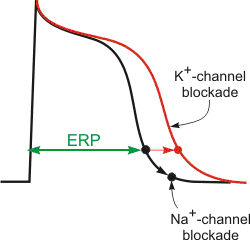 During phases 0, 1, 2, and part of phase 3, the cell is refractory to the initiation of new action potentials. This is termed the effective refractory period (ERP). During the ERP, stimulation of the cell does not produce new propagated action potentials. This is because the fast sodium channels are not fully reactivated and therefore cannot reopen to normal depolarizing stimuli.
The ERP acts as a protective mechanism in the heart by preventing multiple, compounded action potentials from occurring. If these were to occur, the heart could not adequately fill with blood and eject blood. The length of the refractory period limits the frequency of action potentials (and therefore contractions) that can be generated by the heart.
Many antiarrhythmic drugs alter the ERP, altering cellular excitability. For example, drugs that block potassium channels (e.g., amiodarone, a Class III antiarrhythmic) delay phase 3 repolarization and increase the action potential duration, increasing the ERP. Sodium-channel blockers (particularly Class IA) also increase the ERP by prolonging the inactivation state of fast-sodium channels (shown in figure), as well as delaying and inhibiting the activation of outward K+ currents responsible for repolarization. Drugs that increase the ERP can be effective in abolishing reentry currents that lead to tachyarrhythmias.
Revised 11/30/2023
 Twitter
 Telegram
 LinkedIn
 WhatsApp
 Facebook
 Reddit